The reason why your iron keeps running low
Of all the deficiencies in the body, low iron tends to bring the most frustration.
You've been told you're anaemic, or that your ferritin is low. You started the supplement. You added the spinach, the dates, the iron-rich everything. Maybe your haemoglobin nudged up for a while. And then, at the next test, the number had slipped again — and you were left feeling that your own body was refusing the help.
I want to take this one slowly, because iron is a good teacher. It shows you exactly why "eat more of it" so often fails, and it shows you the deeper question hiding underneath the supplement.
First, the physical reasons it isn't sticking
Before any of the emotional layer, there are real, mechanical reasons iron stays low. Your doctor is the right person to investigate these, but you deserve to know they exist, because most people are never told.
Iron is famously hard to absorb. It needs adequate stomach acid to be taken up — and stomach acid drops with age, with stress, and with the acid-blocking medications a lot of people take for years without a second thought.
Then there's inflammation. When the body is chronically inflamed — from autoimmune conditions, from gut issues, from a nervous system stuck on high — it produces more of a hormone called hepcidin, whose entire job is to lock iron away where it can't be used. You can swallow all the iron you like; an inflamed body will keep filing it out of reach. This is one reason iron stays low in people with thyroid and autoimmune conditions specifically.
And then, for many women, there's monthly blood loss that quietly outpaces every effort to replace it.
So if your iron won't hold, the first move is not more supplements. It's working with your doctor to ask *why it isn't absorbing* — acid, inflammation, gut, blood loss. The intake was rarely the real problem.
The layer underneath
Here is where I'll ask you to stay with me, because this part gets misused and I want to handle it with care.
I am not going to tell you that your emotions drained your iron. That's not true, and it's the kind of claim that makes already-exhausted women feel they've failed at yet another thing. The physiology above is real and primary.
But across years of this work, I've watched a pattern repeat too often to ignore. The bodies that run chronically low on iron, again and again, very often belong to people living a particular *shape* of life.
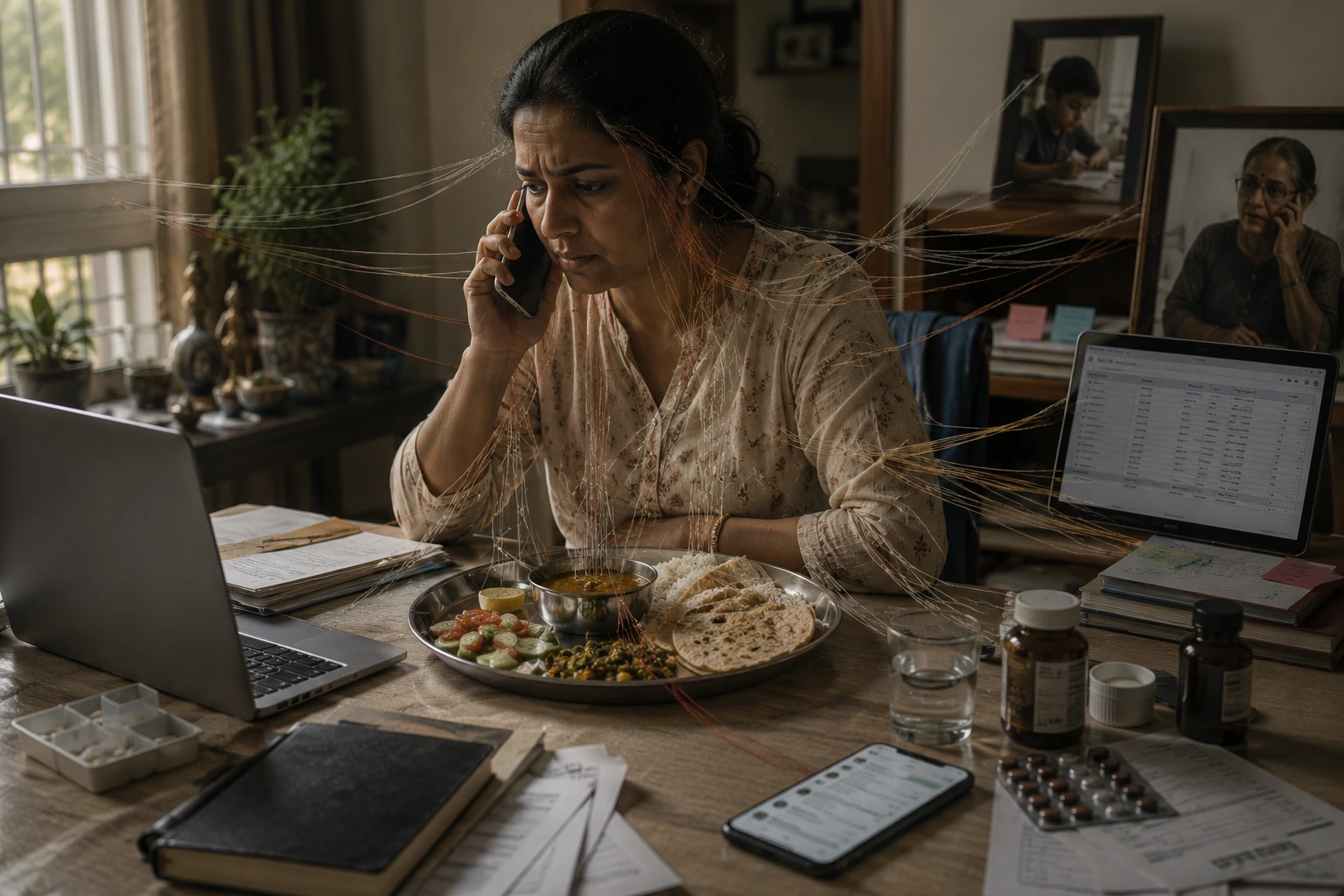
The woman who eats last — and in many of our homes, that is not a personality trait, it's a cultural instruction handed down through generations. The one who has not stopped in years. The one who absorbs everyone else's needs and quietly metabolises her own. The one who has learned that taking up space, asking for more, standing her ground, is not safe or not allowed.
This isn't a character flaw and it isn't a feeling she should have managed better. It's a life that asked for enormous output and offered very little replenishment in return. A body living that life is a body running on a deficit — and iron, the very nutrient that lets us carry oxygen and stand strong, is often the first reserve to run dry.
The body kept the score. It always does.
What iron seems to be pointing at
I offer this as reflection, not mechanism.
Iron is the body's strength. It's what lets your blood carry oxygen, what lets you stand, exert, push back, take up room in the world. Symbolically, it has always struck me as the mineral of *presence and force* — the capacity to be solid and unapologetic in your own space.
So when iron keeps slipping away from someone who has spent years made small — not allowed to be angry, not allowed to need, not allowed to take up space — I don't think that's only a coincidence of diet. I think the body might be naming something. Not causing the deficiency with feeling, but recording, in mineral, a life lived without enough ground to stand on.
You don't have to believe that for it to be useful. You only have to let it become a question.
The two questions worth sitting with
While you and your doctor sort out the physical side — the acid, the inflammation, the absorption — let these run underneath:
*Where in my life have I not been allowed to take up space?*
*What would it mean to stop eating last — literally, and in every other way?*
You may find the answers have nothing to do with your bloodwork. Or you may find they have everything to do with it. Either way, the question is where the deeper work starts — and it's work the supplement was never going to do on its own.
This is one of ten deficiencies I explore in my free guide, *The Emotional Life of a Deficiency* — each one read on two layers, the physical and the human, with the questions worth holding for each. No diagnosis, no blame, just a different way of listening to what your body has been recording.
This article is educational and reflective. It is not medical advice, diagnosis, or treatment. Low iron and anaemia can have serious medical causes and should always be assessed and managed with a qualified healthcare practitioner. Please do not start or stop any supplement or medication based on this article.