Why more girls than boys end up in spectacles, and what the eyes might be describing besides the eyes
I drop and pick up our son from his school, and one thing I've noticed over time is that more girls than boys seem to be wearing glasses. I used to put it down to girls studying more, or scoring better, or maybe something to do with diet. Then I looked at it through the Somashadow lens and found something more interesting.
The Reality Beyond the School Gates
During my research, I searched online and found that it is an observed and statistically proven phenomenon. A study was conducted in India, spanning many states, and more than 2.2 million schoolchildren. And it was found that female sex, urban living, private-school attendance, and increasing age were having significantly more cases of myopia than males.
So what's actually happening?
Most research tries to explain this away by pointing out that girls spend less time outdoors, and there is some truth in that. Green, after all, especially the green of vegetation is said to be good for the eyes. Then there is the reason of diet, that girls get less nutrition etc. But then what about the girls who are eating well and are allowed to spend time outdoors? As with most things when it comes to the female gender, there's usually more to it than one clean explanation.
Past Screen Time and Near Work
Eyes are what we use to observe the world, and in my experience, the things we want to see tend to stay in focus, and what we don't want to see tends to get blurred. And it is not conjecture. I have seen a few cases where a child developed weak eyes within weeks when their parents were going through a discord at home!
Let us see what do girls typically face.
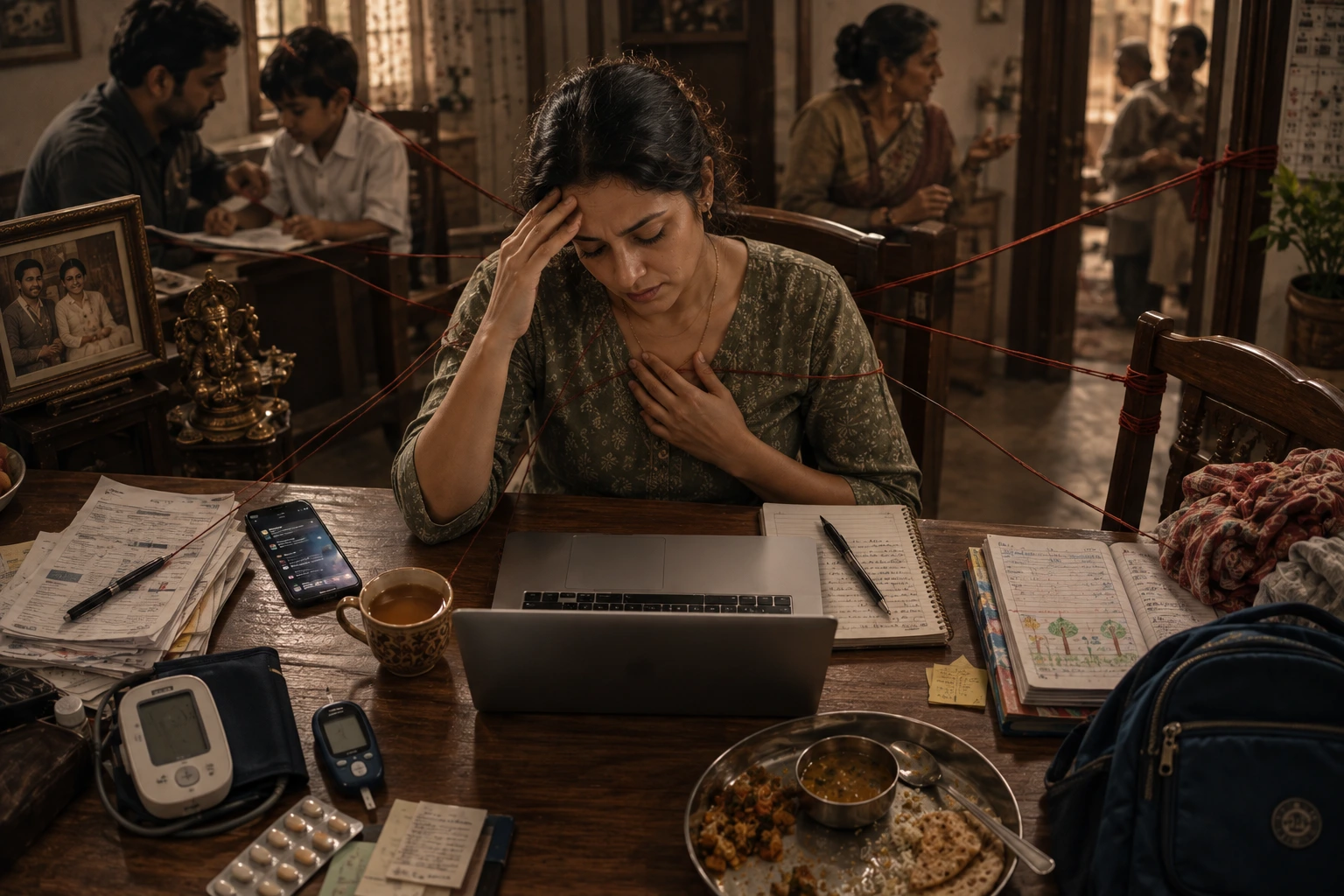
They are told to study properly, come home on time, not to roam around unnecessarily, to not go too far and not to stay out after dark. Then at home she is told to sit properly and be careful about everything from laughter to her clothes. And she ends up always looking at what is nearby. Up close is what is observed, far away can come in later, if it ever does.
What is she actually looking at? Sometimes it is next year, or maybe the next family she will go to? Many girls also learn to monitor themselves far earlier than boys do. How am I sitting? Is my dress okay? Who's looking at me? Did I speak too loudly? What will people think? Is this photograph good enough? Should I have said that?
The Inward Gaze and the Horizon
The physical life as well as her imagined life are repeatedly brought closer. She slowly learns is to focus on what is in front of her and not look too far ahead. She doesn’t simply look at the world, but a major part of her attention is drawn to how she appears to others. She isn't merely seeing but is also being seen, and therefore checking herself. Some girls learn this before adolescence has even properly begun.
So what will happen if she is more into what is near, in front of her than in the distance? And what is myopia if not being able to look at the near world while the far-off world stays blurred? Yes of course, you may say that myopia has well documented physical causes like close work, screen time, reduced outdoor exposure, genetics etc. and I would agree. What I am offering is a psychosomatic lens for a well-documented and proven phenomenon.
And like most psychosomatics, if the underlying cause can be removed, healing can happen, so the eyesight too can improve. I have at least 2 cases till now wherein young women in their 30s were able to get rid of their glasses just by beginning to look at the larger picture.
Sitting With the Questions
So if you have glasses, I would ask you to sit with the question:
- The time just before you were prescribed the glasses, how much of your life happened outside the house?
- Did you have space simply to wander and play?
- Was everything you did was required to be productive?
- Did you spend more time being observed than exploring?
- How far were you allowed to go, physically and metaphorically?
- And did your world become smaller even as you grew older?
Because the spectacles were never the interesting part. But the life the eyes saw and how far life allowed to see, is.