What Your Body Learned Before Your First Period
A girl I know stopped bleeding for seven months. She was fourteen and her periods had started a couple of years earlier, and from the beginning they had felt like something to hide – confusing at first, then embarrassing, then, in her own word, disgusting.
Although she had been told what was happening to her body but what the body absorbed came from the atmosphere around her: the lowered voices, something that got managed in secret and a sense that ‘this’ was not to be spoken of.
And then, her body simply stopped doing it for almost an year. She recalled her exact thoughts at the time:
achha hai, nahi aaya. (Good that it didn't come).
She was relieved! A teenage girl was relieved that her own body had gone quiet and it was much later, after months of work, that she even looked at what might have been going on. Now of course we cannot deduce from one memory alone, everything medically or hormonally that was going on. But the relief itself is important because it tells us something about what menstruation had come to mean inside her body. It tells us that menstruation had not been learned as rhythm, healthy or womanhood, but something unwanted, disgusting, inconvenient and something better avoided.
The instruction arrives before the blood does
We try to suppress menstrual pains by medication, fomentation and what not. Some corporates have even started offering leave for it, all in good faith. But what almost no one asks is – why would something so natural be painful? Here is what nobody says about menstrual pain: that by the time a girl bleeds for the first time, her nervous system has usually already been briefed. Not with words because those only brief the cognitive brain; but with everything else that briefs the nervous system.
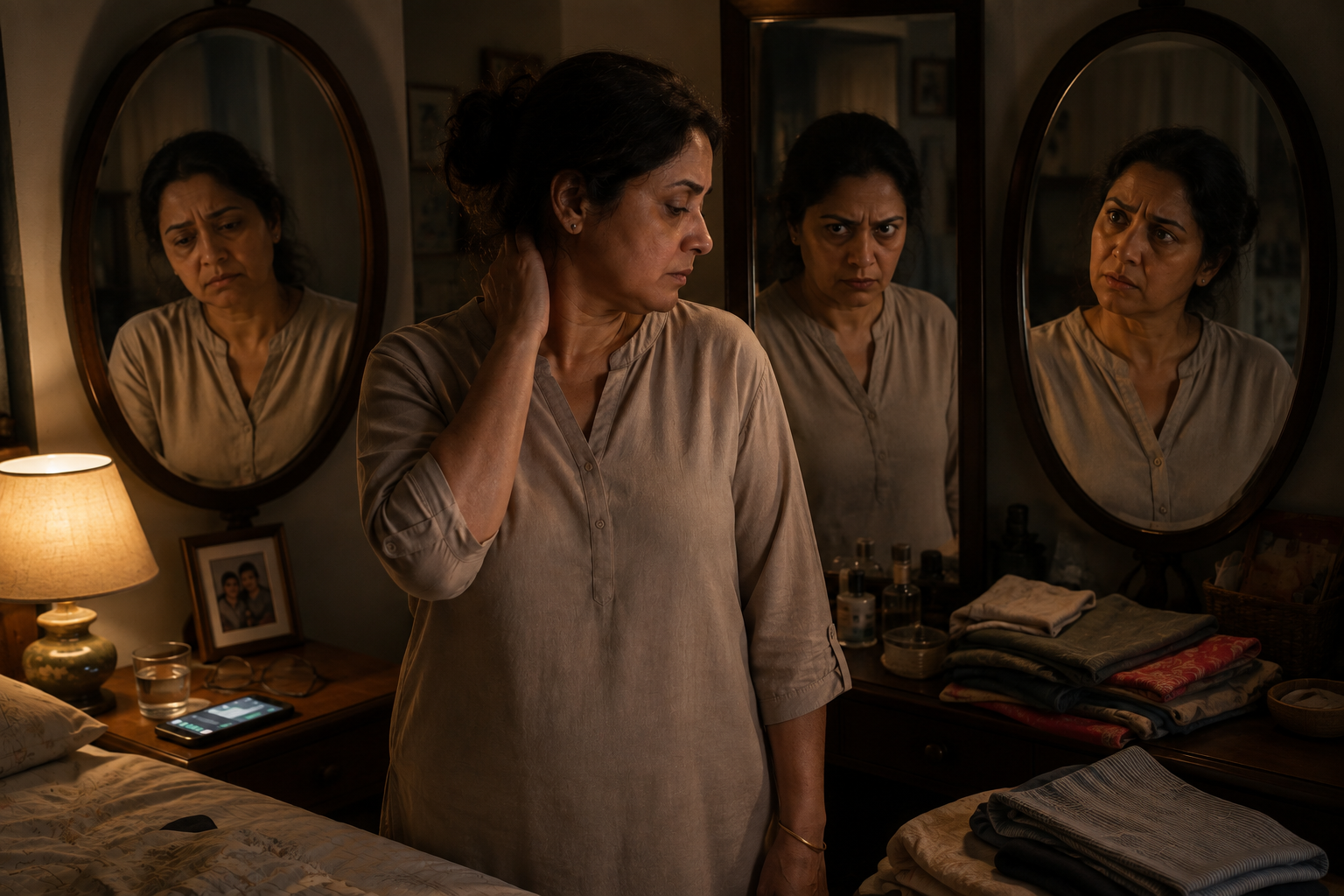
She watched her mother brace each month, watched her disappear with a hot water bottle, or go quiet, or move differently for a few days without explanation (or an “I’ll tell you later). She noticed what made the women around her drop their voices, absorbed the seemingly irrational restrictions placed - don't go there, don't touch that, don't tell anyone and she registered, the expression on a face when the topic came.
No one made her sit and learn that menstruation was shameful. She learnt it in the way children learn most things: by watching what the adults around her do, with their bodies and their silence.
And whatever education she got – through her caretakers, the school sessions, the leaflets etc, reached only the thinking mind. It did not overwrite the conclusions her nervous system arrived at years earlier, not through language but from the very air in the house.
And thus, by the time her own first period arrives, her body already has an expectation in place. The body remembers what it was shown. It does not particularly care what it was later told.
What one woman inherited (and tried to stop)
One woman shared with me what menstruation had meant in her mother's childhood home. Her mother, as a girl, was made to sit in one corner for three days each month. One rag to sit on, one to cover herself - through cold, heat, rain, it made no difference. She could not touch anyone or anything. She was fed stale and leftover food which was handed to her in newspaper or straight into her hands, so that no utensil would be contaminated. When her younger siblings asked why she was sitting apart, they were told that a crow had bitten her — don't go near her for three days.
If someone thinks that good that she got rest – then no, she was not allowed to rest during those three days. She was given the month's dry grains and pulses to clean while she sat. And on the fourth day, she was made to sit with everything she had touched while someone poured water over her to make her ‘clean’ again.
That was that girl's monthly education in what her body meant. Now when she grew up and had a daughter of her own, she decided to break all of it. She made sure her daughter rested and ate fresh, warm food. She refused to pass down the cruelty she had lived through.
But she could not argue with her own parents, so she taught her daughter to hide it. Don't tell grandmother or your father or your brother when you're bleeding.
And so the daughter - cared for, well-fed, allowed to rest, again arrived at the same conclusion her mother and grandmother had reached before her: there is something unclean about this that must be kept from the world.
The rag on the floor was gone. The instruction underneath it continued anyway.
Why this might be living in the pain itself
You may of course, accept all of this as emotional history and still ask that what does any of it have to do with cramps? That is a fair question.
Period pain has a biological pathway. The uterus contracts during menstruation, and prostaglandins are one of the chemicals involved in those contractions. Higher prostaglandin levels are associated with more severe cramps. There are also other clear medical causes of painful periods, including endometriosis, fibroids, adenomyosis and hormonal conditions, and these do need proper medical assessment.
But pain is not experienced by tissue alone. It is experienced by a whole body, with a nervous system, memory, expectation, fear, tension and meaning. Research on primary dysmenorrhea (period pain with no underlying disease) has repeatedly looked at psychological and social factors around period pain. Pain anticipation, anxiety, catastrophising, negative expectations and emotional distress can influence how pain is experienced. This does not mean the pain is imagined. It means that the body’s relationship with the pain matters.
A nervous system that learned early to brace against menstruation does not arrive at each period neutral. It arrives already guarding - the breath changes, belly tightens and the pelvis holds. The body prepares for something it has been taught will be painful, shameful or inconvenient. That preparation may not be the whole cause of the pain. But it may be part of the monthly physiology around it.
And then there is a related, well-documented finding that says that a body under sustained distress can suppress the menstrual cycle entirely – it is termed functional hypothalamic amenorrhea. The medical literature says that it is a protective mechanism: the unduly strained system quietly powers down a function it treats as non-essential to immediate survival. The main drivers studied are usually undereating, over-exercising, low energy, but psychological distress is also one of the established triggers.
I am not saying that your period pain is imaginary, or that it is only psychosomatic. There are real organic causes that produce genuine pain and require medical care. What I am saying is narrower, and harder to see: beneath the medical layer, there is another layer that almost no one examines. What your body learned about menstruation from your environment or your own first experience, may be something it still carries every single month. That layer is difficult to look at. Partly because it runs so deep and partly because it is something that you were taught not to speak about.
The question no one asked you
So here is the question, and it is not a medical one.
What did your body learn about menstruation? Is that learning part of what it brings with it every month?
Not what were you told but what did you absorb - from your mother's body, from your first period, from the silences in your house, from the culture that shaped the women before you?
Most of us have never been asked this. It's hard to examine something you were trained, early and thoroughly, to keep quiet about.
Disclaimer: This is shadow work alongside your medical care, not a replacement for it. Painful periods can have serious organic causes that require diagnosis and treatment. Please see a doctor for persistent or severe menstrual pain.